
PSLE Comprehension Cloze: 8 Common Clue Patterns Pupils Should Recognise

Updated: Sep 6

PSLE Comprehension Cloze can feel unpredictable. A pupil may understand the passage but still struggle to supply the exact word needed for a blank. This often happens because the answer is not found by looking at the blank alone. The clue may appear later in the sentence, in the previous paragraph or through a familiar English expression.
Under the official 2026 PSLE English Language examination format, Comprehension Cloze appears in Booklet B of Paper 2 and contains 15 open-ended items worth 15 marks. Paper 2 assesses whether candidates can use vocabulary and grammar appropriately in context and understand texts at literal, inferential and evaluative levels. These details are stated in the official SEAB PSLE English Language examination format.
This guide explains eight recurring PSLE comprehension cloze patterns and shows pupils what to examine before writing an answer.
Why PSLE Comprehension Cloze Is Challenging
In Grammar Cloze, pupils often know that a blank requires a conjunction, preposition or pronoun. Comprehension Cloze is less direct because it combines several skills:
understanding the passage as a whole
locating clues across sentences
recognising relationships between ideas
selecting precise vocabulary
recalling collocations and fixed expressions
ensuring that the answer fits grammatically
A word may make sense generally but still be rejected because it does not form the correct expression or match the grammar surrounding the blank.
For example:
The safety campaign aims to ___ awareness of the dangers of distracted walking.
Words such as increase and improve may appear reasonable. However, the established collocation is raise awareness. Meaning alone is therefore not enough.
The GLA CLUE Check for PSLE Comprehension Cloze
Before committing to an answer, pupils can perform four checks:
C — Context
What is happening in the sentence and passage? Is the situation positive, negative, surprising, dangerous or successful?
L — Link words
Do words such as however, although, therefore, instead, similarly or as a result reveal how the ideas are connected?
U — Usage
Does the answer form a natural collocation, fixed phrase or idiom with the words around it?
E — English grammar
Does the blank require a noun, verb, adjective, adverb, pronoun or preposition? Does the answer agree with the tense and sentence structure?
An answer should pass all four checks. If it fits the meaning but produces an unnatural phrase, pupils should reconsider it.
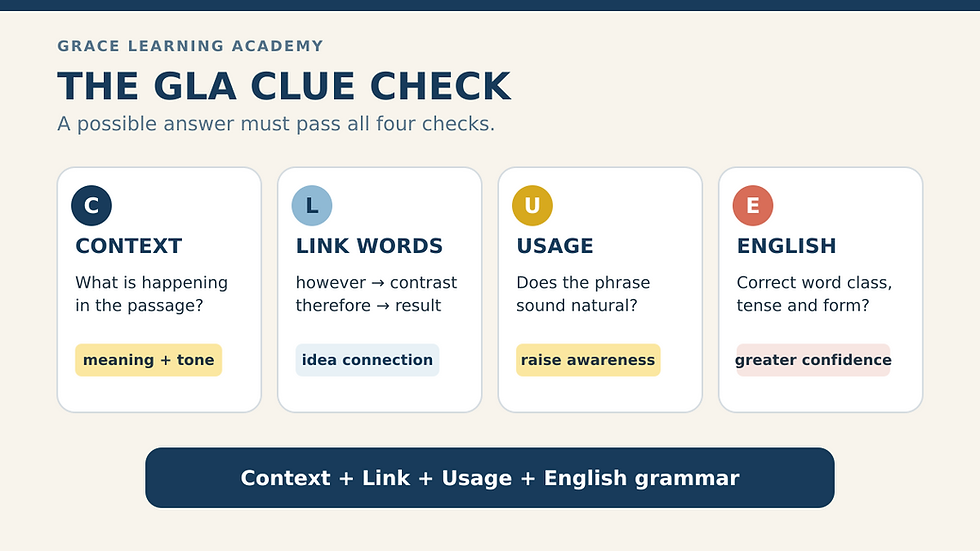
The CLUE Check prevents pupils from choosing a word simply because it sounds possible.
Pattern 1: A Similar Idea Restates the Answer
Writers often express the same idea in two different ways. The sentence before or after the blank may paraphrase, explain or provide examples of the missing word.
Consider:
The heritage fair displayed woven baskets, hand-painted tiles and carved wooden figures. These traditional ___ attracted many visitors.
The examples belong to the broader category of crafts. Pupils should recognise the relationship:
woven baskets, painted tiles and carved figures → traditional crafts
Common forms of similar-idea clues include:
a general category followed by examples
examples followed by a category
a difficult word explained in simpler language
the same event described using a synonym
a pronoun or phrase referring back to an earlier idea
Signal phrases such as in other words, this means, for example and such as may help, but the connection is not always announced explicitly.
What pupils should ask
Which earlier or later words express almost the same meaning as the blank?
Pattern 2: A Contrast Points to the Opposite Idea
Sometimes the passage provides the opposite of the answer. Contrast markers tell pupils that the direction of the idea is changing.
Common contrast signals include:
but
however
although or even though
yet
instead
unlike
whereas or while
despite or in spite of
on the other hand
rather than
For example:
The entrance to the cave was clearly visible in daylight. At night, however, it was almost completely ___.
The word however signals a contrast. If the entrance was visible during the day, it was hidden or invisible at night. Pupils must then use grammar and natural usage to decide which answer fits best.
Contrast may also occur without an obvious connector:
The older equipment was heavy and difficult to move. The new machines were light and ___.
The first sentence establishes a negative feature. The second presents the opposite idea, so portable is a logical answer.

A connector can change the direction of the sentence. Pupils should circle it before answering.
Pattern 3: Cause, Effect and Purpose Reveal What Must Happen
Many blanks can be solved by identifying what caused an event, what resulted from it or why an action was taken.
Useful signals include:
because and since
therefore and thus
consequently
as a result
so that
in order to
due to and owing to
led to or resulted in
Consider:
The organisers placed large signs at every junction so that visitors would not ___ their way.
The purpose of the signs is to prevent visitors from becoming unable to find the route. The fixed expression lose their way provides the answer lose.
Pupils can draw a quick arrow:
clear signs at junctions → visitors do not lose their way
Cause-and-effect clues may cross sentence boundaries, so pupils should not stop reading at the full stop nearest the blank.
What pupils should ask
What happened because of this? What action would create or prevent that result?
Pattern 4: The Passage Refers Back to an Earlier Noun or Idea
A blank may refer to information already stated. Pupils must identify what words such as this, these, such, the former or the latter are pointing to.
For example:
Restoring the mangrove forest will require years of careful work. Local residents have volunteered to support this ___.
The phrase this ___ refers to the work of restoring the forest. Depending on the larger passage, an answer such as effort may capture that idea.
In other cases, the answer itself may be a pronoun:
The damaged bridge was closed immediately because ___ was no longer safe to use.
The pronoun it refers to the damaged bridge.
Pupils should draw a small arrow from the referring word back to the noun or idea it represents. This reduces vague guessing.
Pattern 5: Collocations and Fixed Expressions Limit the Answer
Collocations are words that commonly occur together. Even when several words have similar meanings, English usage may strongly favour one combination.
Compare:
Natural expression | Unnatural or unsuitable alternatives |
raise awareness | lift awareness, grow awareness |
pose a threat | give a threat, make a threat |
play a vital role | do a vital role, work a vital role |
draw attention to | pull attention to, give attention to |
take precautions | make precautions, perform precautions |
reach a decision | arrive a decision, touch a decision |
Idioms and fixed phrases may be even less flexible:
keep an eye on
make ends meet
under the same roof
get out of hand
a matter of time
take something for granted
all walks of life
come as no surprise
For example:
With more visitors arriving every hour, the situation soon got out of ___.
The surrounding meaning suggests that the situation became difficult to control. The fixed expression is get out of hand, so the answer is hand.
Pupils cannot master collocations through rules alone. Regular reading, correction and keeping a phrase bank are important.

Record complete phrases—not isolated words—when reviewing Comprehension Cloze mistakes.
Pattern 6: Grammar Pairings Supply the Missing Partner
Some structures contain two parts. When one part appears, pupils should check whether its matching partner belongs in the blank.
Common pairings include:
First part | Matching part |
not only | but also |
either | or |
neither | nor |
both | and |
between | and |
from | to |
too | to |
so | that |
such | that |
no sooner | than |
For example:
The programme not only taught participants how to grow vegetables ___ also showed them how to reduce food waste.
The phrase not only signals the matching structure but also. Since also is already provided, the blank requires but.
Another common pattern involves prepositions:
The volunteers were committed ___ protecting the wildlife reserve.
The expression is committed to, and a verb after the preposition to takes the -ing form: committed to protecting.
Pattern 7: The Sentence Reveals the Required Word Class or Form
After identifying the likely meaning, pupils must determine the grammatical form required.
Look immediately before and after the blank:
an article such as a, an or the may signal a noun
a possessive word such as his or their is often followed by a noun
a modal verb such as can, may or should is followed by a base-form verb
a linking verb such as seemed or became may be followed by an adjective
a preposition is usually followed by a noun, pronoun or -ing form
an adverb may be needed to describe how an action happened
For example:
After weeks of rehearsal, Nabil delivered his speech with greater ___.
The preposition with and adjective greater signal that the blank requires a noun. The natural phrase is with greater confidence.
A pupil who writes confident has identified the correct idea but supplied the wrong word class.
Pattern 8: Precise Meaning, Tone and Intensity Decide Between Possible Words
Some blanks seem to accept several synonyms until the surrounding details are examined carefully.
Consider the differences:
looked — neutral
glanced — looked quickly
stared — looked for a long time
glared — looked angrily
peered — looked carefully because it was difficult to see
Now consider:
Unable to see clearly through the thick mist, Farah ___ into the distance.
The clue unable to see clearly points to peered, not merely looked.
Pupils should examine:
the character's emotion
whether the action is sudden or gradual
the strength of the reaction
whether the tone is positive or negative
the writer's attitude
the physical conditions surrounding the action
Choosing the most sophisticated word is not the goal. Choosing the most precise word is.
A Five-Step Method for Every PSLE Comprehension Cloze Passage
Step 1: Read the whole passage without filling any blanks
Identify the topic, main idea, setting and overall tone. Notice whether the passage explains, recounts, persuades or describes.
Step 2: Complete the most certain blanks first
Grammar pairings and familiar fixed expressions are often easier to confirm. Completing them may make the passage clearer.
Step 3: Mark the clue for every answer
Underline a similar idea, circle a contrast marker, draw a cause-and-effect arrow or connect a referring word to its earlier noun.
Step 4: Apply the CLUE Check
Check Context, Link words, Usage and English grammar. Do not accept an answer that passes only one or two checks.
Step 5: Read the completed passage from beginning to end
Check that the tense, tone and meaning remain consistent. Pay special attention to singular and plural forms, verb forms, spelling and repeated words.

The final reread should sound natural and make sense across the whole passage.
Common Mistakes Pupils Make
Reading only the sentence containing the blank
The decisive clue may appear several sentences earlier or later.
Copying a nearby word without checking grammar
The passage may provide the correct idea but require a different word form or pronoun.
Writing the first synonym that comes to mind
Words with similar dictionary meanings may differ in intensity, tone and collocation.
Ignoring connectors
Missing words such as however or therefore can reverse or redirect the meaning.
Using an unnatural phrase
An answer may be understandable but not form accepted English usage with the surrounding words.
Leaving the answer unchanged after the final reread
Pupils sometimes notice that a sentence sounds wrong but keep the answer because they do not know what to replace it with. They should return to the clue type and test another possibility systematically.
How to Review Comprehension Cloze Mistakes Properly
Instead of recording only the correct word, pupils should write down why it was correct.
Blank | My answer | Correct answer | Clue pattern | What I missed |
raise awareness | grow | raise | collocation | I knew the meaning but not the natural phrase |
however, it was ___ | visible | hidden | contrast | I ignored the connector |
committed ___ helping | for | to | grammar pairing | I did not recall “committed to” |
This turns each correction into a reusable lesson. Over time, pupils may notice that they repeatedly struggle with the same area, such as fixed expressions, reference words or precise verbs.
How Parents Can Help at Home
Parents do not need to supply the answer immediately. Ask questions that guide the child back to the text:
Which words give you a clue?
Is the second idea similar to or different from the first?
Is there a connector near the blank?
What word class is required?
Does that phrase sound natural in English?
Can you explain why your answer fits the whole passage?
Encourage the child to underline evidence. If the child cannot point to any clue, the response may be based on guessing rather than reasoning.
PSLE English Support at Grace Learning Academy
At Grace Learning Academy, pupils are taught to identify recurring question patterns, annotate contextual clues and explain why an answer fits. Cloze practice is followed by targeted correction so pupils learn from the relationship between meaning, grammar and natural language use—not merely from an answer sheet.
Parents looking for systematic PSLE English support can learn more about our Primary English tuition programme in Serangoon.
Final Thoughts
PSLE Comprehension Cloze is not a collection of unrelated blanks. It is a connected passage containing patterns that guide the reader towards the intended meaning.
When pupils learn to recognise similar ideas, contrasts, references, cause-and-effect relationships, collocations and grammar structures, they become less dependent on guessing. The goal is not to find a word that merely fits the blank. It is to find the word that fits the context, connection, usage and grammar of the entire passage.


Comments