
PSLE Listening Comprehension 2026: 10 Tips to Avoid Careless Mistakes


Listening Comprehension may seem like one of the more manageable PSLE English components. After all, pupils listen to a text and select an answer. However, some answer options can be very similar. A pupil may hear a familiar word, choose the first plausible answer and overlook the detail that changes the meaning completely. Doing well therefore requires more than good hearing. Pupils need to read ahead, compare the options, follow the complete message and verify their answers carefully.
According to the official 2026 PSLE English Language syllabus, Listening Comprehension is Paper 3. It consists of 20 multiple-choice questions worth 20 marks, carries 10% of the overall English grade and lasts approximately 35 minutes. Graphic representations are used for the first seven items. Each text is read twice, and pupils are given time to read the questions before the first reading of each text.
For 2026, the English Listening Comprehension examination will be held on Tuesday, 15 September, from 11.15 am to 11.50 am. SEAB notes that the actual duration may differ slightly. Parents can confirm the details in the official 2026 PSLE examination timetable.
Why PSLE Listening Comprehension Requires More Than Good Hearing
The paper assesses pupils’ understanding of spoken texts at the literal, inferential and evaluative levels. Pupils may need to identify:
the main idea;
a specific detail;
a speaker’s purpose, attitude or opinion;
the correct sequence of events;
a reason or outcome; or
the final decision after a plan changes.
Tasks may be based on different types of audio texts with purposes such as recounting, entertaining, instructing, describing, informing, explaining, responding, arguing, evaluating or persuading.
This means pupils must adjust the way they listen according to the purpose of the text.
For example, an announcement may test a changed time or venue. A conversation may require pupils to match an opinion to the correct speaker. A story may test the sequence in which events occurred. The vocabulary may not be especially difficult. The challenge lies in selecting the answer that reflects the complete meaning accurately.
10 PSLE Listening Comprehension Tips
1. Read the Question Before Studying the Options
Use the given reading time to identify exactly what the question is asking.
Look for the key focus:
Who performed the action?
Why did something happen?
Where will the event take place?
What happened first or last?
How does the speaker feel?
If pupils study the options without first understanding the question, every choice may appear possible.
The question tells them what kind of information to listen for.
2. Compare the Differences Between the Options
Do not read each option in isolation. Compare the options and identify the small details that make them different.
For example:
10.15 am / 10.30 am / 10.45 am
library entrance / school foyer / general office
borrow the equipment / return the equipment / collect the equipment
These differences reveal what pupils must listen for.
They can lightly underline the person, place, time or action that distinguishes one option from another. This gives them a clear listening target before the text begins.

3. Study Graphic Representations Carefully
The first seven items use graphic representations. Before the text is read, pupils should examine the options and identify the feature that distinguishes one representation from another.
For example, three pictures may show:
a boy carrying an umbrella;
a boy wearing a raincoat; and
a boy waiting under a shelter.
The pupil should not merely think, “This question is about rain.”
The more useful question is:
Which action or object will the spoken text confirm?
Pupils should pay attention to details such as direction, position, number, sequence and action. These differences are usually more important than the general setting.
4. Listen for Words That Signal a Change
A common mistake is selecting an earlier plan instead of the final decision.
Pupils should listen carefully for words and phrases such as:
but;
however;
instead;
actually;
eventually;
in the end; and
rather than.
Consider this example:
“We planned to meet outside the library, but it may rain. Let’s wait in the school foyer instead.”
The library is mentioned first, but the final meeting place is the school foyer.
When pupils hear a contrast or change signal, they should pay close attention to the information that follows it.
5. Match Each Detail to the Correct Speaker
In conversations involving two or more people, pupils may remember the correct idea but connect it to the wrong person.
They can track the conversation mentally:
Speaker A makes a suggestion.
Speaker B disagrees.
Speaker A changes the plan.
Names, roles and pronouns matter. If a question asks what Mei thinks, a correct statement made by Ravi may still be the wrong answer.
Pupils should therefore listen not only for what is said, but also for who says it.
6. Distinguish the Main Idea From a Supporting Detail
A spoken text may contain several true details, but only one option captures its main purpose.
Suppose a speaker mentions the cost of reusable bottles, where they can be purchased and how long they last. If the overall message encourages pupils to reduce plastic waste, an option about where to buy a bottle is only a supporting detail.
Pupils should ask:
What is the speaker mainly trying to tell, explain or persuade us to do?
The correct main-idea answer should represent the spoken text as a whole, not merely one isolated sentence.
7. Do Not Select an Answer Only Because Its Words Were Mentioned
An option may repeat words heard in the spoken text and still be incorrect.
For example:
“Nadia did not choose the art workshop because it ended too late.”
An option that says “Nadia attended the art workshop” contains the familiar words art workshop, but it reverses the meaning.
Pupils must listen for the relationship between the words. They should be especially alert to negatives and limiting expressions such as:
not;
never;
except;
only; and
hardly.
Hearing a matching word is not enough. The complete meaning must match.
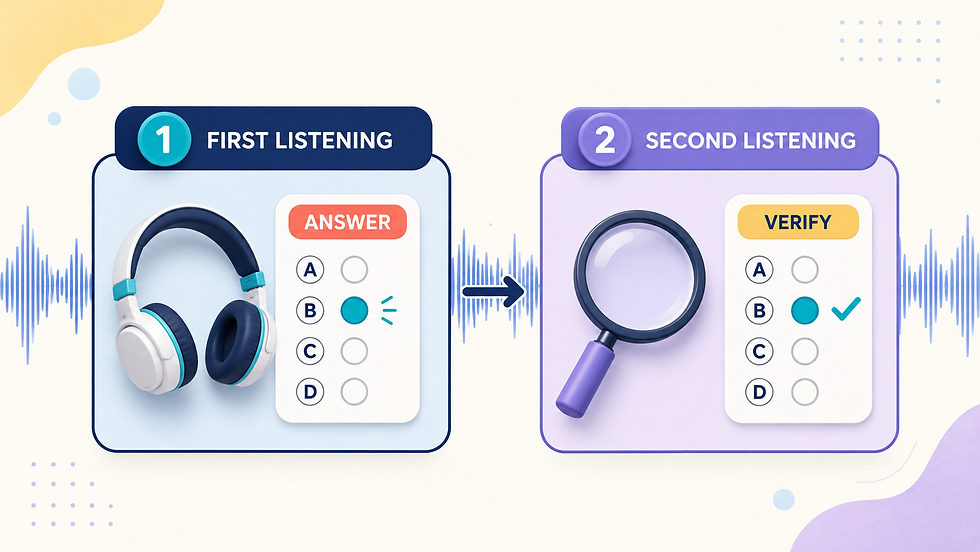
8. Use the First Reading to Answer and the Second to Verify
Pupils should not wait until the second reading to begin answering.
During the first reading, they should:
follow the overall meaning;
select the most likely answer; and
mark any uncertain item discreetly.
During the second reading, they should:
listen for the exact detail separating the options;
confirm or change their answer; and
check whether a later statement changed an earlier plan.
The second reading is an opportunity to verify a decision using a specific listening target.
9. Move On Quickly If One Detail Is Missed
If pupils continue replaying a missed phrase in their minds, they may miss the next important detail too.
Once the spoken text moves on, their attention must move with it.
They should choose the most reasonable option based on what they heard, mark the item for checking and refocus immediately.
One uncertain answer should not affect the remaining questions.
10. Check the Answer Against the Complete Meaning
Before confirming an answer, pupils should ask:
Is every part of this option correct?
Did I confuse the first plan with the final plan?
Did I match the detail to the correct speaker?
Did I overlook a negative word?
Does the answer express the main idea or only one detail?
An option that is only partly true is still incorrect. The best answer must fit the complete meaning of the spoken text.

Five Common Listening Comprehension Distractors
The terms below are teaching categories used to help pupils review their mistakes. They are not official SEAB question labels.
Distractor | What happens | What pupils should check |
Changed plan | The first choice is replaced later | Listen after “but”, “instead” or “in the end” |
Wrong speaker | The idea is correct but belongs to someone else | Match names and roles carefully |
Similar detail | Times, numbers or places sound alike | Compare the exact differences before listening |
Reversed sequence | All the events occurred, but their order is wrong | Track what happened first, next and last |
Partial truth | Only part of the option is correct | Check the whole option, not only familiar words |
A Worked Listening Comprehension Example
Imagine that pupils hear the following text:
“Marcus intended to cycle to the community centre. However, the dark clouds worried his mother. His brother offered to drive him, but the car would not start. In the end, Marcus took the bus.”
Question: How did Marcus travel to the community centre?
A. By bicycleB. By carC. By bus
Answer: C. By bus
All three forms of transport are mentioned.
A pupil who selects the first familiar detail may choose the bicycle. Another pupil may hear that Marcus’s brother offered to drive him and choose the car.
However, the phrase “In the end” signals the final outcome.
This example shows why pupils must follow the complete spoken text instead of answering as soon as they hear one matching word.
How to Practise PSLE Listening Comprehension at Home
Completing more practices is useful only when pupils review why each mistake occurred.
After an exercise, they can classify each incorrect answer under one of these categories:
missed keyword;
changed plan;
wrong speaker;
wrong sequence;
main idea confused with a supporting detail;
negative word overlooked; or
option only partly correct.
This creates a simple listening error log.
If the same type of mistake appears repeatedly, the pupil knows which listening habit requires more attention.
Parents can also ask three short questions after reviewing an answer:
Which word or phrase confirmed the correct answer?
Which detail made the other option incorrect?
Did the speaker change or qualify the original idea?
These questions train pupils to justify answers using evidence instead of intuition.
A Simple Final-Week Practice Plan
Pupils do not need to complete paper after paper without reflection. A focused routine can be more useful.
Days 1 and 2: Practise the items with graphic representations and compare the differences between the options.
Days 3 and 4: Focus on conversations, speaker matching and changed plans.
Day 5: Practise questions involving main ideas, purposes and inferences.
Day 6: Complete one full practice under appropriate listening conditions.
Day 7: Review the error log and complete a short, light practice.
During practice, pupils should keep to the normal two readings. Replaying a text repeatedly may make the activity feel easier without developing examination-ready listening habits.

What Pupils Should Do on Examination Day
Before the first text begins, pupils should:
sit calmly and focus on the instructions;
use the reading time fully;
compare the differences between the options; and
predict whether they need to identify a person, place, time, reason, action or opinion.
While listening, they should:
listen to the complete sentence;
notice words that signal contrast or change;
answer during the first reading;
verify during the second reading; and
move on promptly if one item remains uncertain.
Careful listening is active. Pupils should approach each text knowing what information they need to identify.
Strengthen PSLE English Skills with Grace Learning Academy
Listening Comprehension improves when pupils learn how to compare options, identify possible distractors and support each answer with an exact spoken clue.
These habits also strengthen concentration, inference and comprehension across the wider English examination.
At Grace Learning Academy, our Primary English classes provide structured, skills-based guidance across PSLE English Paper 1, Paper 2, Listening Comprehension and Oral Communication. Pupils learn not only which answer is correct, but also how to recognise the clues and reasoning that lead to it. Parents who would like targeted English support for their child can contact Grace Learning Academy to enquire about available classes or a trial lesson.
Final Thoughts
PSLE Listening Comprehension is not a test of memory alone.
Strong listeners read with purpose, compare similar options, follow the complete message and use the second reading to verify their initial choice. In the final days before the examination, pupils should focus on the mistakes they make most frequently. A few deliberate improvements can protect valuable marks and help them approach the paper with greater calm and control.


Comments