
PSLE Oral 2026: How to Structure Strong Stimulus-Based Conversation Answers


With the PSLE Oral Examination taking place on 12 and 13 August 2026, Primary 6 students are now entering the final stage of their oral preparation.
At this point, simply practising more questions may not be enough. Students should focus on answering confidently, developing their ideas and supporting their opinions with relevant examples and personal experiences.
According to the official SEAB 2026 PSLE timetable, the oral examination will be conducted across two days. The official PSLE English examination format also confirms that Oral Communication carries 40 marks and accounts for 20% of the English examination.
This makes oral an important opportunity for students to strengthen their overall English results.
What Is the PSLE Oral Format for 2026?
The PSLE English Oral Communication examination consists of two parts:
Part 1: Reading Aloud
Students read a passage aloud and are assessed on their:
Pronunciation and articulation
Fluency and pacing
Expression
Ability to read according to the purpose, audience and context
Reading Aloud carries 15 marks.
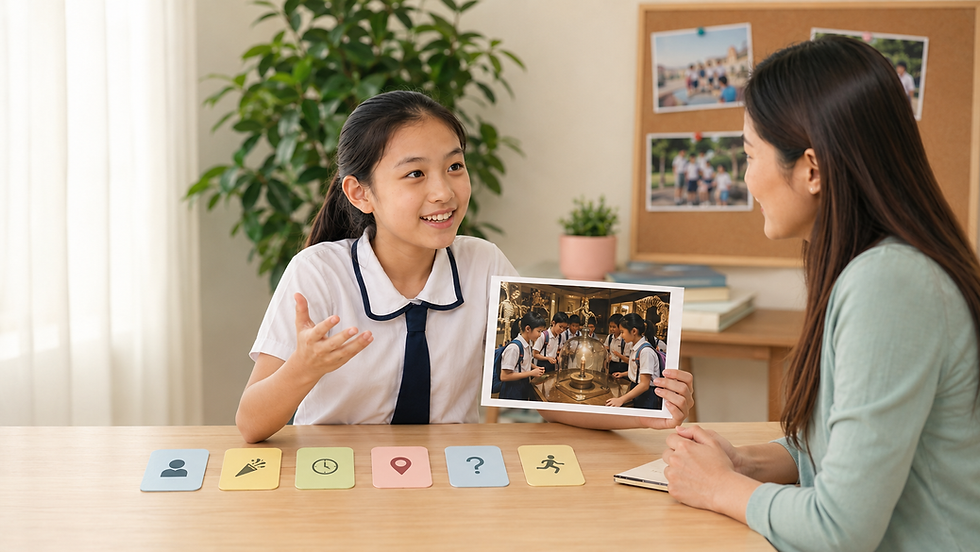
Part 2: Stimulus-Based Conversation
Students engage in a conversation with the examiners based on a photo stimulus.
They are assessed on their ability to:
Express opinions and ideas clearly
Share relevant personal experiences
Speak fluently and accurately
Use appropriate vocabulary and sentence structures
Engage the listener
Stimulus-Based Conversation carries 25 marks.
Students receive five minutes of preparation time, followed by approximately five minutes of examination time. The Reading Aloud passage and Stimulus-Based Conversation photograph are not thematically linked.
Why Do Students Struggle with Stimulus-Based Conversation?
Many pupils understand the question but give answers that are too brief.
For example:
Yes, I think school excursions are useful because students can learn new things.
The answer is relevant, but it is not sufficiently developed. The student has stated an opinion without explaining it fully.
Other students memorise impressive phrases but struggle to use them naturally. Some give several reasons that are repetitive, while others share personal experiences that do not answer the question.
A strong answer needs both structure and substance.
Three Common Types of PSLE Oral Questions
Students should learn to recognise the type of question before deciding how to answer it.
1. Photo-Based Questions

These questions require students to observe and interpret the photograph.
Examples include:
What do you think is happening in the photograph?
How do you think the people are feeling?
What can you tell about the activity shown?
Would you enjoy taking part in this activity?
Students should support their interpretations with visible evidence instead of making unsupported guesses.
Instead of saying:
The boy is nervous.
A stronger response would be:
I think the boy may be feeling nervous because he is gripping the microphone tightly and looking down instead of making eye contact with the audience.
The student has made an inference and supported it with a visual clue.
Using SVGSC for Questions About Feelings
For questions that specifically ask how the people in the photograph might be feeling, students can use the SVGSC structure:
S – State: State the person’s likely emotion.
V – Visual clues: Identify relevant facial expressions.
G – Gestural clues: Describe the person’s posture or actions.
S – Spatial clues: Consider the person’s position and interaction with others.
C – Conclusion: Give an overall interpretation.
This framework is specifically meant for photograph questions about people’s feelings. It should not be forced into every photo-based question.
2. Opinion and Preference Questions
These questions ask students to take a clear stand.
Examples include:
Do you think school excursions are useful?
Would you prefer exercising alone or with friends?
Should children help with household chores?
Do you think technology improves learning?
For opinion questions, students can use the SEPC framework.

S – State Your Opinion
Answer the question directly.
Yes, I believe school excursions are a valuable way for pupils to learn.
Avoid taking too long to reach the main point. The examiner should understand the student’s position immediately.
E – Elaborate on Your Reasons
Develop the opinion with clear reasons, explanations and examples.
Students can aim to provide three reasons when appropriate. However, each reason must add something new.
Useful signposting phrases include:
Firstly, I believe this because…
Another reason is that…
Furthermore…
This allows students to…
For example…
As a result…
P – Share a Personal Experience
A relevant personal experience makes the answer more convincing and engaging.
Students can use 5W1H to develop their experience:
Who was involved?
What happened?
When did it happen?
Where did it happen?
Why was it meaningful?
How did the student feel or respond?
C – Conclude Clearly
End by reinforcing the main opinion or explaining what was learnt.
Therefore, I believe school excursions should remain an important part of learning because they make lessons more meaningful and memorable.
PSLE Oral Model Answer Using SEPC and 5W1H
Question: Do you think school excursions are a good way for pupils to learn?
Yes, I believe school excursions are a good way for pupils to learn.
Firstly, excursions make learning more engaging because pupils can observe things in a real environment instead of merely reading about them in a textbook. This can capture their attention and encourage them to become more curious.
Secondly, experiencing something firsthand makes information easier to understand and remember. For example, visiting a historical site can help pupils visualise what life was like in the past.
Lastly, school excursions allow pupils to learn with their classmates. They can discuss what they observe, complete activities together and learn from one another.
I remember visiting the Science Centre with my classmates last year. Our teacher brought us there as part of our science lesson. We conducted simple experiments and explored several interactive exhibits about electricity. I had previously found the topic rather confusing, but the demonstrations helped me understand it more clearly. I also enjoyed discussing the exhibits with my friends.
Therefore, I believe school excursions are valuable because they make learning more enjoyable, interactive and memorable.
3. Personal-Experience Questions
These questions require students to recount something that happened to them.
Examples include:
Tell me about a time you helped someone.
Tell me about an enjoyable learning experience.
Have you ever taken part in a community activity?
Tell me about a time you had to overcome a challenge.
Students sometimes give vague responses such as:
I helped my friend with his homework before. I felt happy.
Instead, they should develop the experience using 5W1H and include a meaningful reflection.
A complete personal experience should explain:
The setting and people involved
What happened
What the student did
How others responded
How the student felt
What the student learnt
The experience does not need to be dramatic. A simple but well-developed and believable experience is more effective than an exaggerated story.
Common PSLE Oral Mistakes to Avoid
Giving One-Line Answers
Even when the initial answer is correct, the student should explain why and provide supporting details.
Repeating the Same Idea
“Learning is enjoyable”, “learning is fun” and “learning is interesting” are essentially the same point. Each reason should contribute a different idea.
Using Memorised Phrases Unnaturally
Power phrases are useful, but students should understand their meanings and use them in suitable contexts. Examiners are looking for clear communication, not a rehearsed speech.
Giving Irrelevant Personal Experiences
A long personal story will not earn additional credit if it does not answer the question. Every part of the experience should support the student’s main point.
Making Assumptions About the Photograph
Students should refer to facial expressions, body language, actions, objects or interactions that can actually be seen.
Speaking Too Quickly
Speaking rapidly can cause students to lose clarity and make grammatical mistakes. A steady pace with natural pauses makes an answer easier to follow.
A 15-Minute Daily PSLE Oral Practice Routine
During the final weeks before the examination, students can follow this short routine each day:
Three Minutes: Observe a Photograph
Identify:
The setting
The people involved
Their actions and expressions
The likely topic
Possible questions connected to the photograph
Five Minutes: Answer One Opinion Question
Use SEPC:
State the opinion
Elaborate with clear reasons
Add a relevant personal experience
Conclude
Five Minutes: Develop One Personal Experience
Use 5W1H and end with a reflection.
Two Minutes: Review the Response
Check:
Did I answer the exact question?
Did I explain my reasons?
Did I give specific details?
Did I repeat any ideas?
Did I speak clearly and naturally?
Recording the response can also help students notice repeated words, awkward pauses and unclear pronunciation.
Final PSLE Oral Preparation Tips
In the last few weeks, students do not need to memorise dozens of perfect model answers. Instead, they should learn how to adapt familiar ideas to different questions.
They should also revise common themes such as:
Technology and learning
Health and well-being
Kindness and inclusivity
Family and relationships
Hobbies and talents
Environmental responsibility
Public transport and road safety
Community behaviour
Wildlife and pets
Showing appreciation
The goal is not to predict the exact PSLE Oral topic. It is to build enough knowledge, vocabulary and personal examples for students to respond confidently to different themes.
At Grace Learning Academy, our Primary 5 and Primary 6 English students practise different oral question types using structured frameworks, topic-based vocabulary, guided worksheets and individual feedback. Students are taught to move beyond short answers and express their ideas clearly, naturally and confidently.
For more information about our Primary English tuition and PSLE English preparation classes in Serangoon, contact us to arrange a trial class.


Comments