
O-Level Editing: 8 Grammar Error Patterns Students Must Recognise

Updated: Sep 6

O-Level Editing can appear deceptively simple. Students read a short passage, circle the incorrect word in each numbered line and write the correct replacement word. Yet many lose marks because they rely on whether a sentence “sounds right” instead of testing its grammatical structure.
This is especially risky when the sentence contains a long subject, several verbs or a familiar expression that masks the error.
The solution is not to memorise hundreds of isolated corrections. Students need to recognise recurring grammatical relationships and check them systematically. This guide explains eight common error patterns and introduces an anchor-first method that makes the correction process more reliable.
What Does O-Level Editing Require?
Under the 2026 Singapore-Cambridge GCE O-Level English Language Syllabus 1184, Editing appears in Paper 1, Section A and carries 10 marks.
Candidates identify and correct grammatical errors in a short passage of continuous prose not exceeding 250 words. The official syllabus also states clearly that punctuation and spelling are not tested in this section.
Therefore, students should focus on grammar in context. They must understand the passage well enough to recognise relationships involving subjects, verbs, time, pronouns, word forms and sentence structures.
A common misconception
Students sometimes change a word merely because another expression sounds more elegant. However, Editing is not a rewriting exercise. The aim is to correct a grammatical error while preserving the writer’s intended meaning.
For example:
The volunteers worked careful throughout the event.
The problem is not that “careful” is an unimpressive word. An adverb is required to modify the verb “worked”, so the correct form is:
The volunteers worked carefully throughout the event.
The correction is determined by grammar, not style.
Use the Anchor-First Editing Method
Instead of scanning randomly for a word that looks unusual, begin with the grammatical anchor of the sentence.
Step 1: Read the entire passage for meaning
Identify the topic, general time frame and sequence of events. A tense choice that appears possible in one line may conflict with the rest of the passage.
Step 2: Locate the main subject and verb
Ignore interrupting phrases temporarily. Ask who or what performs the action, then check whether the verb agrees with that subject.
Step 3: Look for a controlling word or structure
Certain words create grammatical expectations:
modal verbs require the base form;
prepositions are followed by nouns or gerunds;
“each” and “every” usually introduce singular nouns;
paired conjunctions require parallel structures;
time markers control tense choices.
Step 4: Circle the Incorrect Word and Write the Correct Word
Circle the word that is incorrect in the numbered line. Then write the correct replacement word in the answer space. You do not need to rewrite the sentence.
Step 5: Reread the full sentence
Check whether the correction fits both the sentence and the surrounding passage. A locally grammatical answer can still be wrong if it disrupts tense or meaning across the paragraph.

Eight Common O-Level Editing Error Patterns
These categories are not an exhaustive list of every possible grammar error. They are high-value patterns that students should be able to recognise and explain.

Pattern 1: Subject-Verb Agreement
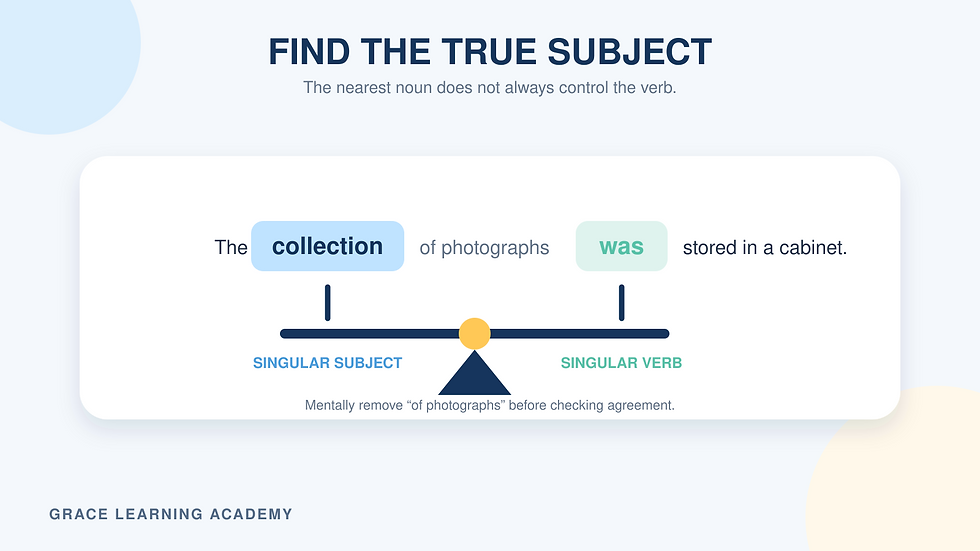
The verb must agree with the true subject, not the noun closest to it.
Example 1
The collection of old photographs were stored in a cabinet.
The subject is “collection”, which is singular. The phrase “of old photographs” does not control the verb.
Correction: were → was
Example 2
Each of the volunteers receive a name tag.
“Each” is singular even though it refers to members of a group.
Correction: receive → receives
What to check
subjects separated from verbs by long phrases;
“each”, “every”, “either” and “neither”;
indefinite pronouns such as “everyone” and “someone”;
compound subjects joined by “and”; and
structures beginning with “there is” or “there are”.
Pattern 2: Tense and Time Consistency
Tenses show when events happen and how they relate to one another. Students should look beyond the verb itself and locate time markers or surrounding verbs.
Example 1
Last week, the committee launches its recycling campaign.
“Last week” places the event in the past.
Correction: launches → launched
Example 2
The workshop began at nine yesterday and ends at noon.
Both completed actions belong to the same past sequence.
Correction: ends → ended
What to check
explicit time markers such as “yesterday”, “since” and “by the time”;
verbs joined within the same sequence;
changes between background actions and main events; and
shifts between general truths and specific past events.
Do not force every verb into the same tense. Different tenses may be correct when they express different time relationships.
Pattern 3: Incorrect Verb Forms
A controlling word often determines the form of the next verb.
After modal verbs
Students should brings their identification cards.
A modal verb such as “should” is followed by the base form.
Correction: brings → bring
After prepositions
She is interested in learn more about photography.
The preposition “in” should be followed by a noun or gerund.
Correction: learn → learning
After particular verbs
Students should avoid to share personal information online.
“Avoid” is followed by a gerund.
Correction: to share → sharing
Students should build awareness of patterns such as:
enjoy doing;
avoid doing;
decide to do;
encourage someone to do; and
prevent someone from doing.

Pattern 4: Articles, Determiners and Quantifiers
Articles and determiners must match the noun’s number, sound and meaning.
Example 1
The workshop gave us an useful introduction to coding.
“Useful” begins with a consonant sound, /y/.
Correction: an → a
Example 2
Every participants received a certificate.
“Every” is followed by a singular countable noun.
Correction: participants → participant
Example 3
Less students attended the afternoon session.
Use “fewer” with plural countable nouns.
Correction: less → fewer
Students should distinguish:
many / much;
fewer / less;
a few / a little;
every / all; and
a / an / the / no article.
Pattern 5: Pronoun Form, Agreement and Reference
Pronouns must fit their grammatical role and refer clearly to a suitable noun.
Example 1
The organisation thanked we for our contribution.
The pronoun follows the verb “thanked” and functions as an object.
Correction: we → us
Example 2
The camera stopped working because their battery was flat.
The possessive pronoun refers to the singular noun “camera”.
Correction: their → its
What to check
subject forms: I, he, she, we, they;
object forms: me, him, her, us, them;
possessive forms: my, his, her, our, their, its;
reflexive forms: myself, ourselves, themselves; and
whether the reference is clear and consistent.
Avoid applying an oversimplified rule without reading the context. Collective nouns may be treated differently depending on whether the group acts as one unit or as separate members.
Pattern 6: Prepositions and Fixed Grammatical Pairings
Prepositions often appear in established pairings. Translating directly from another language or relying only on general meaning can produce errors.
Examples
The student was responsible of organising the materials.Correction: of → for
Many residents were concerned for the increase in traffic.Correction: for → about
The course is suitable to beginners.Correction: to → for
Useful pairings include:
responsible for;
interested in;
capable of;
concerned about;
suitable for;
participate in; and
contribute to.
Students should record these as complete phrases rather than isolated prepositions.
Pattern 7: Connectors and Clause Structures
Connectors control the relationship between ideas and the grammatical structure that follows.
Example 1
Despite the journey was tiring, the students remained cheerful.
“Despite” is followed by a noun phrase or gerund, not a full clause in this structure.
Correction: Despite → Although
Example 2
Because of the rain was heavy, the match was postponed.
“Because of” requires a noun phrase. A full clause follows here.
Correction: Because of → Because
Students should compare:
although + clause / despite + noun phrase;
because + clause / because of + noun phrase;
unless / if…not; and
while / whereas for contrast.
The correction must preserve the intended logical relationship, not simply produce a grammatical sentence.
Pattern 8: Word Forms and Parallel Structures
A word may express the correct general idea but appear in the wrong grammatical form.
Word-form example
The guide explained the procedure clear.
An adverb is required to modify “explained”.
Correction: clear → clearly
Parallel-structure example
She enjoys reading, swimming and to cycle.
The items in the list should use the same grammatical pattern.
Correction: to cycle → cycling
Check whether the sentence requires a:
noun: success;
verb: succeed;
adjective: successful; or
adverb: successfully.
Also compare items joined by “and”, “or”, “both…and” and “not only…but also”. Similar ideas should normally use parallel grammatical forms.
Worked O-Level Editing Practice
The following original passage is designed to practise the eight patterns above. Decide whether each numbered line contains a grammatical error. If it does, identify and correct it. If it is correct, mark it as having no error.
Practice passage
Last Saturday, a group of student volunteers were preparing a food distribution event.
Each participant received a list of families who needed support.
Before packing began, the organiser reminded everyone to work careful.
Several boxes of canned food was placed beside each table.
The volunteers checked every item to ensure that it had not expire.
They also separated products that were unsuitable to young children.
Although the morning was busy, the students remained patience.
One volunteer suggested creating clearer labels for future events.
By noon, the team had packed all the parcels and deliver them to the collection point.
The experience taught the students that small actions can have a meaningful effect in others.
Answers and explanations
Line | Answer | Explanation |
1 | were → was | The true subject is the singular collective noun “group”. |
2 | No error | “Each participant” is singular and agrees with “received”. |
3 | careful → carefully | An adverb is required to modify “work”. |
4 | was → were | The subject “boxes” is plural. |
5 | expire → expired | “Had not” requires the past participle. |
6 | to → for | The correct pairing is “suitable for”. |
7 | patience → patient | An adjective is required after the linking verb “remained”. |
8 | No error | “Suggest” can be followed by a gerund: “suggested creating”. |
9 | deliver → delivered | The two verbs controlled by “had” require parallel past participles. |
10 | in → on | The correct expression is “have an effect on”. |
Why Students Miss Errors Even When They Know the Rule
1. The wrong noun attracts attention
In “The box of materials was heavy”, students may make the verb agree with “materials” because it appears nearby. They must identify the grammatical head “box”.
2. Familiarity hides the error
A phrase may sound acceptable because students have heard it repeatedly in informal speech. Examination grammar requires standard English structures.
3. They correct meaning instead of grammar
Replacing a word with a stronger synonym does not solve the task if the original word is grammatically correct.
4. They inspect each line in isolation
Tenses and pronoun references may depend on information from an earlier sentence.
5. They stop after making a local correction
The new word may fit the immediate phrase but create disagreement elsewhere. Always reread the full sentence.
A Practical Revision Routine
Editing improves fastest when students review errors by category rather than completing passages without analysis.
After each practice:
label the error type;
write the controlling grammar rule;
create one new sentence using the same pattern;
record common fixed pairings as complete phrases; and
revisit the error several days later without looking at the answer.
For example:
Error | Category | Rule | New example |
were → was | Subject-verb agreement | The verb agrees with “group”, not “players”. | The team of athletes was exhausted. |
to → for | Preposition | Use “suitable for”. | The activity is suitable for beginners. |
This turns one correction into a transferable rule.
Final O-Level Editing Checklist
Before moving to Situational Writing, ask:
Did I read the entire passage before correcting individual lines?
Did I identify the true subject and main verb?
Did I check the passage’s time frame?
Did I look for controlling words such as modals and prepositions?
Did I check pronoun form and reference?
Did I test articles, determiners and quantifiers against the noun?
Did I check fixed prepositional pairings?
Did I preserve the writer’s intended meaning?
Did I avoid making unnecessary stylistic changes?
Did I reread every corrected sentence in context?
How Parents Can Support Editing Practice
Instead of asking only, “What is the correct answer?”, ask the student:
Which word or structure controls your correction?
A student who can explain “The subject is singular, so the verb must be singular” is more likely to recognise the same pattern in an unfamiliar sentence.
Keep an error log organised by categories such as subject-verb agreement, tenses, prepositions and word forms. When the same category appears repeatedly, revise the underlying rule before attempting another full passage.
Strengthen O-Level Grammar with Grace Learning Academy
Editing is not separate from writing. The same control of agreement, tenses, word forms and sentence structures affects students’ Language marks in Situational Writing and Continuous Writing.
At Grace Learning Academy, our Secondary and IP English programme uses targeted grammar practice, error analysis and guided writing to help students apply rules accurately in context.
For another Paper 1 resource, read our guide on how to write an O-Level feature article.
If your child needs support with O-Level English grammar, writing or comprehension, contact Grace Learning Academy to discuss a suitable class or assessment.
Final Thoughts
Strong editors do not search randomly for words that look strange. They identify the grammatical anchor, test the relationship, circle the incorrect word and write the correct replacement word.
Learn the recurring patterns. Explain the rule behind every mistake. Then reread the corrected sentence in context.
With consistent, category-based practice, O-Level Editing becomes a test of reasoning rather than guesswork.


Comments