
O-Level Argumentative Essay Writing: A Step-by-Step Guide

Updated: Sep 6

Many O-Level students have no difficulty giving an opinion. Ask whether social media is harmful, whether examinations are necessary or whether artificial intelligence should be used for homework, and most will have something to say.
The challenge begins when that opinion has to become a convincing essay.
A strong O-Level argumentative essay needs more than three reasons, several connectors and a conclusion beginning with “In a nutshell”. The writer must interpret the exact wording of the question, take a defensible position, explain how each reason works, support it with suitable evidence and respond thoughtfully to an opposing view.
This guide breaks those skills into clear steps for Secondary 3 and 4 students preparing for O-Level English. The aim is not to memorise one model essay. It is to learn a thinking process that can be adapted to different Continuous Writing questions under examination conditions.
What Is Tested in O-Level Continuous Writing?
Under the 2026 Singapore-Cambridge GCE O-Level English Language Syllabus 1184, candidates choose one of four Continuous Writing topics and write 350–500 words. The section carries 30 marks: 10 marks for Content and 20 marks for Language. The topics may require different text types, including an argument.
For the highest Content band, all aspects of the task must be fully addressed and developed in detail. For Language, examiners look for coherent organisation, clarity, accurate language and effective use of ambitious vocabulary and grammatical structures. These requirements are stated in the official 2026 SEAB English Language syllabus.
This explains why an essay with relevant points can still remain average. Relevance is only the starting point. Students must develop and connect their ideas convincingly.
Opinion Is Not the Same as Argument
Consider this statement:
Schools should limit students’ use of artificial intelligence for learning. Do you agree?
An opinion may sound like this:
I agree because students may become lazy and AI is not always reliable.
The position is clear, but the reasoning is still undeveloped. What does “lazy” mean in this context? How does dependence develop? What would students stop doing? Why would that affect their learning? What form should the limit take?
An argument goes further:
Schools should place reasonable limits on students’ use of artificial intelligence because unrestricted dependence may allow pupils to bypass the intellectual struggle needed to develop independent reasoning. If students routinely generate complete answers before attempting a task themselves, they may submit polished work without being able to reproduce the same thinking during examinations or discussions.
The second response explains a cause-and-effect chain. It does not merely announce a belief; it shows the reader why that belief is reasonable.
Step 1: Decode the Argumentative Essay Question
Students sometimes start generating points after reading only the broad topic. This is risky because two questions about the same topic may demand different arguments.
Before planning, apply the Question Lens:
1. Identify the key issue
What exactly is being debated? In the sample question, the issue is not whether AI exists or whether it is useful. It is whether schools should limit its use for learning.
2. Examine the qualifier
Words such as always, only, too much, most, entirely, necessary and beneficial affect the strength of the claim.
For example, “Technology is harmful” is a much more absolute statement than “Young people depend too heavily on technology”. An absolute claim is easier to challenge because one credible exception can weaken it.
3. Establish the scope
Who, where and under what circumstances does the statement apply?
In the sample question:
Who? Students
Who acts? Schools
What activity? The use of AI for learning
What action? Limit, not necessarily ban
4. Follow the command
“Do you agree?” requires a clear position. “What are the advantages and disadvantages?” requires balanced discussion. “To what extent?” requires the writer to judge the degree to which the statement is valid.

Step 2: Choose a Clear and Defensible Stand
A stand should be more precise than “I agree” or “It depends”. It should tell the reader what the writer believes and reveal the central reasoning behind that belief.
Compare these positions:
Weak or vague stand | Clearer stand |
I agree that schools should limit AI. | Schools should limit unsupervised AI use because students need to retain independent thinking and schools need reliable evidence of what pupils can do. |
It depends on how students use it. | AI should remain available as a guided learning tool, but schools should restrict its use when a task is intended to assess a student’s unaided thinking. |
I agree to a certain extent. | Although AI can provide useful feedback and explanations, reasonable limits are necessary to prevent it from replacing the thinking that learning requires. |
A nuanced stand is not the same as an indecisive one. A student can recognise complexity while still making a firm judgement.
Before committing to a position, test it with three questions:
Can I support this stand with at least two distinct reasons?
Can I explain why each reason matters?
Can I answer the strongest objection to my position?
If the answer is no, the position may be too extreme, too vague or too difficult to defend with the student’s available knowledge.
Step 3: Build an Introduction That Sets Up the Argument
An argumentative introduction does not need a dramatic quotation or a dictionary definition. It needs to establish the issue and give the essay a clear direction.
At Grace Learning Academy, students can use HOKST as a planning checklist:
H — Hook: Introduce the tension, trend or debate.
O — Overview: Give brief context without writing a full body paragraph.
K — Keywords: Clarify an important term if the question could be interpreted in different ways.
S — Stand: State a firm answer to the question.
T — Thesis: Preview the main reasoning that will support the stand.
These elements do not have to appear as five separate sentences. They should flow naturally.
Weak introduction
Technology is very common nowadays. There are advantages and disadvantages of artificial intelligence. In this essay, I will discuss whether schools should limit AI. I agree that they should.
The introduction repeats the topic but does not establish a meaningful line of argument.
Improved introduction
Artificial intelligence can now explain difficult concepts, generate practice questions and offer feedback within seconds. Yet the same convenience can allow students to submit work that reveals little about their own understanding. Schools should therefore limit, rather than completely prohibit, the use of AI in learning. Clear boundaries are necessary to protect independent thought and academic integrity while preserving AI’s value as a supervised learning tool.
The improved version defines the proposed response—limits rather than a total ban—and previews the essay’s main considerations.
Step 4: Develop Body Paragraphs with PEEL+
Many students know PEEL, but their paragraphs still feel short because the “Explanation” and “Example” remain superficial. Use PEEL+ to deepen the reasoning:
P — Point: State one reason that supports the stand.
E — Explain: Show how or why the effect occurs.
E — Evidence or example: Provide a specific illustration.
L — Link: Explain what the example proves and reconnect it to the question.
+ Evaluation: Consider significance, scale, conditions or limitations.
A list-like paragraph
Firstly, AI makes students overdependent. They may use it for homework. For example, they can ask AI to write their essays. Therefore, schools should limit AI.
Every sentence is relevant, but the paragraph does not explain the process or its significance.
A developed paragraph
One reason schools should limit unsupervised AI use is that constant dependence may weaken students’ ability to reason independently. Productive learning often requires pupils to struggle with a question, test an idea and recognise why an initial approach has failed. If an AI tool supplies a complete response at the first sign of difficulty, students may skip this thinking process altogether. For instance, a pupil who repeatedly generates essay plans and polished paragraphs may complete homework quickly but struggle to construct an argument during a timed examination without digital assistance. The concern is therefore not convenience itself, but whether convenience replaces the mental effort through which competence is built. Reasonable limits protect that effort while still allowing teachers to use AI purposefully.
Notice that the stronger paragraph does not simply add more sentences. Each sentence performs a different job and moves the argument forward.
Step 5: Use Examples as Evidence, Not Decoration
An example is useful only when it supports the exact claim being made. Students do not need to fill every paragraph with statistics or famous case studies. They need examples that are specific, credible and clearly interpreted.
Useful evidence may include:
a relevant event or policy the student understands accurately
an observation from school, family or the community
a plausible scenario that illustrates a cause-and-effect relationship
a comparison between two situations
a well-explained personal experience, if it suits the topic
Students should never invent precise statistics, study names or expert quotations merely to sound authoritative. A believable, well-explained example is stronger than a fabricated figure.
Most importantly, follow an example with an evidence link:
This illustrates that…
The example is significant because…
What this reveals is that…
This matters particularly when…
These phrases are not magical connectors. Their value lies in forcing the writer to explain how the example proves the point.
Step 6: Write a Genuine Counterargument and Rebuttal
A counterargument shows that the writer understands a credible opposing view. It should not be deliberately weak or unrealistic.
For the AI question, a genuine counterargument would be:
AI can make learning more accessible by giving immediate explanations, adapting practice to a student’s needs and allowing pupils to seek clarification without embarrassment.
That is a reasonable benefit. The rebuttal should respond to it directly:
However, these benefits do not require unrestricted use. Schools can allow AI for guided revision while requiring unaided work during assessments and asking students to disclose how the tool supported their process. Such boundaries preserve accessibility without allowing AI to replace the student’s own judgement.
A useful four-part rebuttal sequence is:
Acknowledge the strongest opposing point fairly.
Explain why that point appears persuasive.
Challenge or qualify its assumption, limitation or extent.
Reaffirm why the original stand remains stronger overall.

Step 7: Create Cohesion Across the Whole Essay
Cohesion is not achieved by beginning every paragraph with Firstly, Secondly, Thirdly and Lastly. These signposts may show order, but they do not explain the relationship between ideas.
Use connectors according to their purpose:
Purpose | Useful language |
Add a related idea | Furthermore, equally important, another concern is… |
Show cause and effect | Consequently, this may lead to…, as a result… |
Introduce contrast | However, nevertheless, by contrast… |
Qualify a claim | In many cases, particularly when…, provided that… |
Introduce an opposing view | Critics may argue that…, supporters of this view contend that… |
Rebut | This argument overlooks…, while this concern is valid…, however… |
Evaluate | More importantly, in the long term, the deeper issue is… |
Students should also connect paragraphs through key ideas. If the introduction establishes the difference between AI as a tool and AI as a substitute, the body and conclusion can return to that distinction. This gives the essay conceptual unity.
Step 8: End with Judgement, Not Repetition
A conclusion should not copy the introduction word for word or introduce an entirely new argument.
It should:
restate the stand using fresh language;
synthesise the main reasoning;
acknowledge the key condition or qualification, if relevant; and
end with a broader judgement or practical implication.
Weak conclusion
In a nutshell, AI has advantages and disadvantages. I still agree that schools should limit it. With great power comes great responsibility.
This ending is generic and could be attached to many unrelated essays.
Improved conclusion
Ultimately, schools should not treat AI as either an enemy to ban or a shortcut to accept without question. Sensible limits are necessary because education must still reveal what students can understand, create and defend independently. When AI supports those abilities instead of replacing them, technology can strengthen learning without weakening the learner.
The improved conclusion returns to the essay’s central distinction and leaves the reader with a clear judgement.
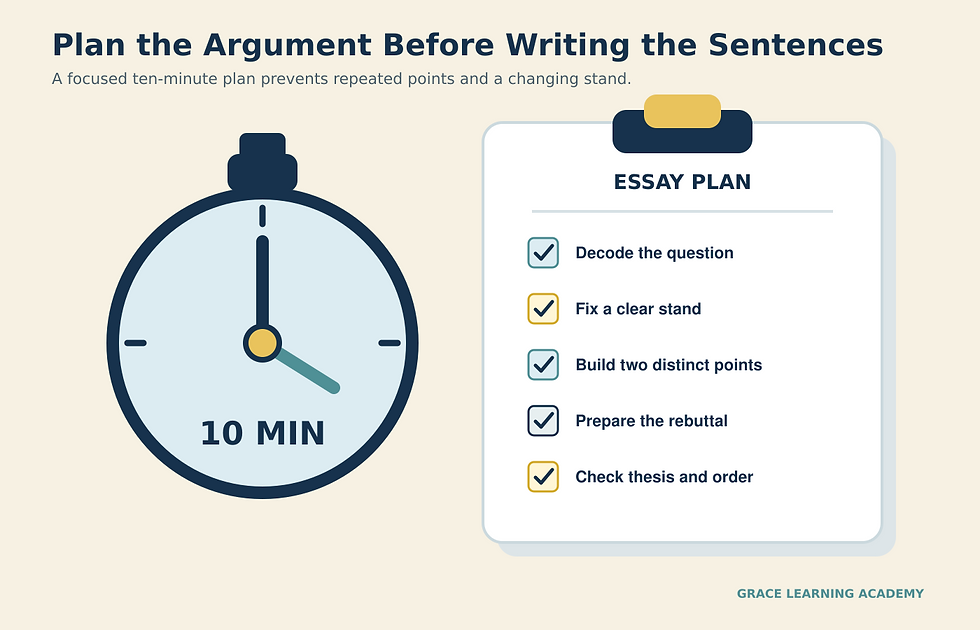
A 10-Minute Argumentative Essay Planning Routine
Minutes 1–2: Decode the question
Underline the issue, qualifier, scope and command. Paraphrase the debate in one sentence.
Minutes 3–4: Decide the stand
Write one precise position. Avoid a stand that changes halfway through the plan.
Minutes 5–6: Build two main arguments
For each point, note the cause-and-effect chain, one example and what the example proves.
Minutes 7–8: Prepare the counterargument
Choose the strongest reasonable opposing point and write the exact response to it.
Minute 9: Draft the thesis
Decide how the main points will be previewed without sounding like a mechanical list.
Minute 10: Check progression
Arrange the arguments from logical foundation to broader consequence. Confirm that every paragraph supports the same overall stand.
Common Mistakes in O-Level Argumentative Essays
1. Answering the topic instead of the question
A student writes everything they know about technology but never evaluates whether schools should impose limits.
2. Repeating one reason in different words
“Students become dependent”, “students rely on AI” and “students cannot work without AI” may all be the same core argument. Each body paragraph needs a distinct purpose.
3. Treating an example as self-explanatory
After giving an example, students must state what it demonstrates and how it strengthens the claim.
4. Using absolute language without proof
Claims such as “AI will destroy education” or “all teenagers are addicted to technology” are difficult to defend and weaken credibility.
5. Adding a token counterargument
One sentence beginning with “Some people may disagree” does not show evaluation. The opposing point and the response both need development.
6. Forcing sophisticated vocabulary
Ambitious language earns credit only when it is accurate and appropriate. A precise word such as dependency, integrity, accessibility or accountability is more effective than an obscure expression used incorrectly.
7. Memorising complete essays
A memorised essay rarely matches the question perfectly. Students should retain flexible ideas, examples, reasoning patterns and useful vocabulary—not fixed paragraphs that are forced into every task.
Model O-Level Argumentative Essay
Question: Schools should limit students’ use of artificial intelligence for learning. Do you agree?
Artificial intelligence can now explain difficult concepts, generate practice questions and offer feedback within seconds. Yet the same convenience can allow students to submit work that reveals little about their own understanding. Schools should therefore limit, rather than completely prohibit, the use of AI in learning. Clear boundaries are needed to protect independent thought and academic integrity while preserving AI’s value as a supervised educational tool.
First, unrestricted AI use may weaken the independent reasoning that education is meant to develop. Learning often requires students to wrestle with uncertainty, test an idea and discover why an initial answer is inadequate. If a digital tool supplies a polished response immediately, this valuable process may disappear. A student who routinely asks AI to plan and write an essay may complete homework efficiently, yet be unable to construct the same argument during a timed examination. The problem is not that the task becomes easier, but that the appearance of competence may replace competence itself. Schools are therefore justified in requiring students to attempt important tasks independently before using AI for feedback.
Limits are also necessary to maintain fair and meaningful assessment. Teachers use assignments to identify misconceptions, evaluate progress and decide what support a student needs. When AI generates substantial parts of an answer, the submitted work may no longer represent the learner’s ability. As a result, a teacher may overestimate the student’s mastery and fail to address genuine weaknesses. Schools could respond by requiring process notes, short oral explanations or supervised writing for selected tasks. Such measures do not punish students for using technology; they ensure that assessment still serves its educational purpose.
Admittedly, strict restrictions may appear counterproductive because AI can make learning more accessible. It can rephrase a confusing explanation, create additional practice or provide immediate guidance when a teacher is unavailable. These benefits are especially valuable for students who need more time or feel hesitant about asking questions. However, useful support does not require unrestricted dependence. Schools can permit AI during guided revision while disallowing it when a task is designed to measure unaided thinking. Students can also be taught to verify information, acknowledge the tool’s contribution and explain why they accepted or rejected its suggestions. This approach develops digital judgement instead of encouraging blind reliance.
Ultimately, schools should not treat AI as either an enemy to ban or a shortcut to accept without question. Sensible limits are necessary because education must still reveal what students can understand, create and defend independently. When AI strengthens these abilities instead of replacing them, technology can support learning without weakening the learner.
Approximate word count: 430 words
How Parents Can Support Argumentative Writing at Home
Parents do not need to correct every grammatical error or supply “better points”. Instead, ask questions that make the student’s reasoning visible:
What does the key word in the question mean?
What exactly is your stand?
Why does this effect happen?
What would be a specific example?
What does your example prove?
What would someone who disagrees say?
Why is your position still stronger?
Allow the student to explain the plan aloud before writing. If the reasoning is unclear in speech, it will probably remain unclear on the page.
After the essay is completed, focus the first round of feedback on one or two high-impact areas, such as paragraph development or rebuttal. Correcting every line at once may overwhelm the student without showing which weakness matters most.
Secondary English Support at Grace Learning Academy
At Grace Learning Academy, argumentative writing is taught as a sequence of thinking and writing skills. Students learn how to interpret questions, form defensible positions, develop cause-and-effect reasoning, choose credible examples, construct rebuttals and refine language through targeted feedback.
Our Secondary/IP English programme also supports Situational Writing, comprehension, summary, oral communication and language accuracy through structured resources and regular practice.
Final Thoughts
A convincing argumentative essay does not depend on having the most dramatic opinion or the longest list of examples. It depends on disciplined reasoning.
Students should read the question precisely, commit to a clear stand, explain how each effect occurs, use examples as proof and engage honestly with an opposing view. With regular practice and specific feedback, argumentative writing becomes less about guessing what sounds impressive and more about making a judgement the reader has good reason to accept.


Comments